
The State of AI in Venue and Event Management: Interest Is High, but Execution Is Still Early
Momentus Technologies’ Q1 2026 research shows a venue industry that believes AI will matter, but has not yet embedded it into the workflows that run booking, staffing, coordination, and live event execution.


Momentus Technologies’ new Q1 2026 report captures an industry that has moved past curiosity and into expectation. Venue and event leaders across North America, EMEA, and Asia-Pacific increasingly believe AI will shape the next phase of operations, but most have not yet applied it in meaningful ways across the functions that actually run a building and deliver events. The report, based on a survey of hundreds of venue and event management professionals, points to a market that sees the opportunity clearly while still operating in the early stages of adoption.
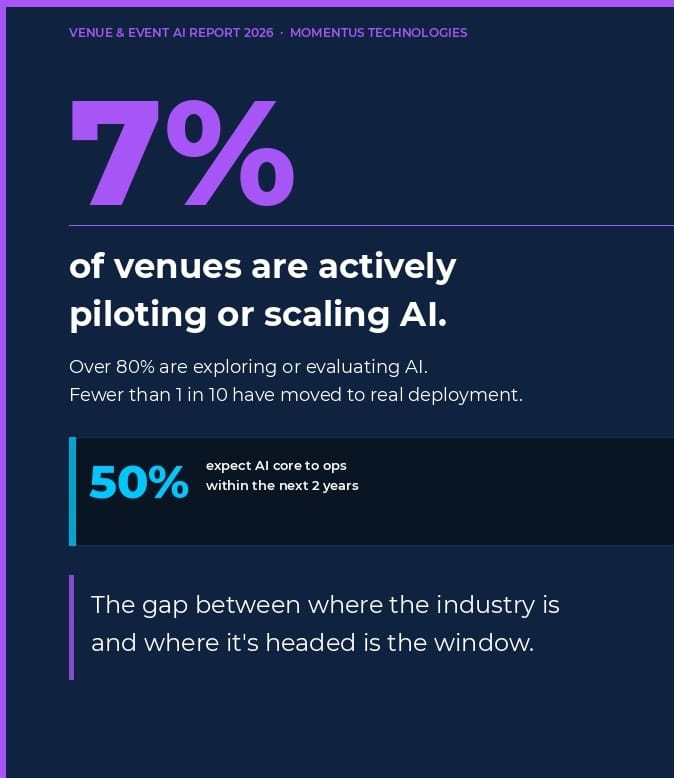
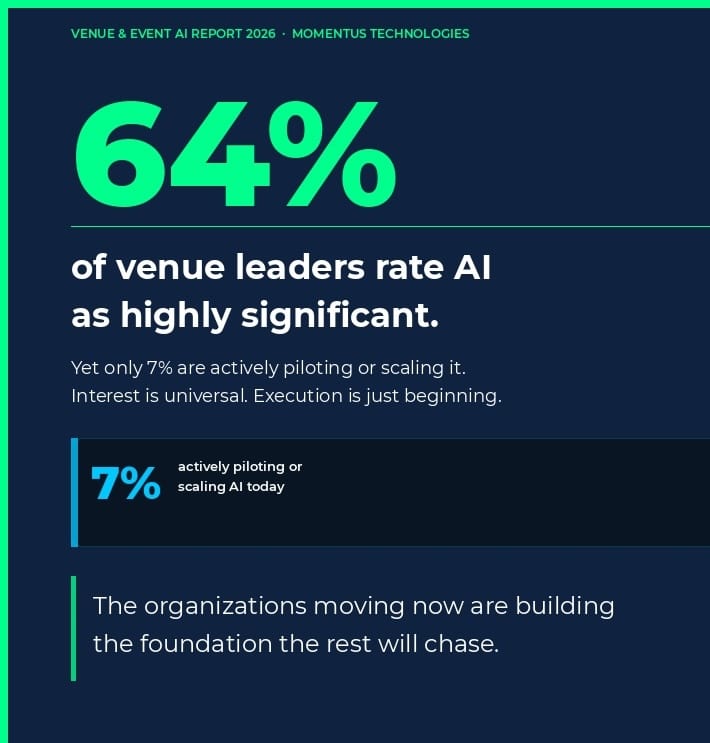
The sharpest gap in the report sits between belief and action. Sixty-four percent of respondents rate AI as highly significant, yet only 7% are actively piloting or scaling use cases today. More than 80% are exploring or evaluating AI, but most organizations have not moved into real deployment. The industry is largely aligned on AI’s importance. It is not yet aligned on execution.
Where AI is being used today reinforces that point. Current adoption is concentrated in lower-risk tasks such as knowledge management, content creation, and general productivity support, while core operational workflows remain largely untouched. Momentus found that 45% expect AI to become part of day-to-day operations within one to two years, even though only 4% say they are already there. The timeline is moving faster than operational change inside most organizations.
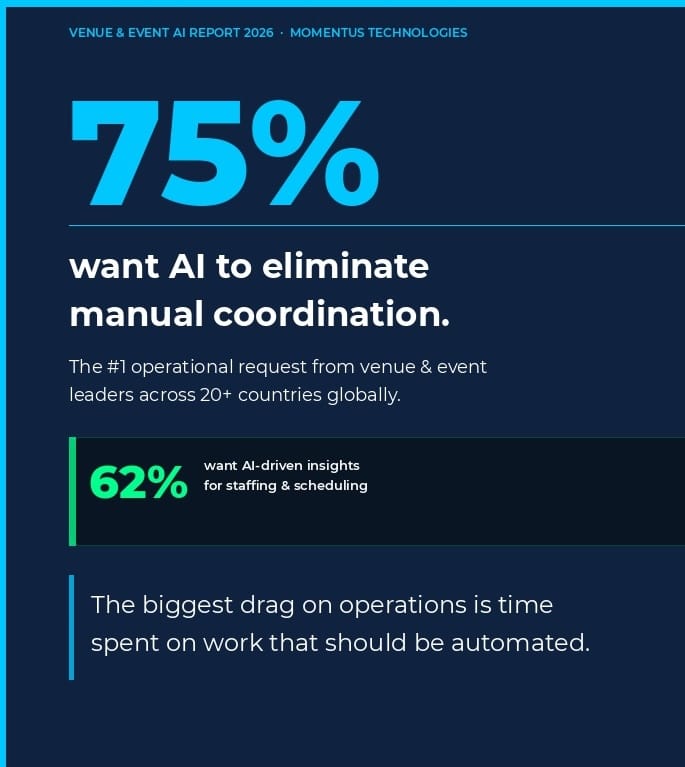
The most revealing section of the report may be what venue teams actually want AI to do. This is far less about abstract transformation and far more about removing friction. Seventy-five percent want help with data entry and administrative work, while 62% want operational insights and summaries that support better decisions. When asked which operational decisions would benefit most from improved technology, 71% pointed to coordinating changes across teams and 60% pointed to forecasting staffing and resource needs. The pressure points are obvious: too much manual coordination, too much time lost to admin, and too little real-time visibility.
That same theme carries through when respondents were asked which single burden they would eliminate first. Forty-two percent chose manual coordination across teams. Another 29% chose post-event reporting and reconciliation. Those answers point directly at the categories where AI has the clearest near-term value for operators: less time spent chasing updates, fewer handoffs falling through the cracks, and faster access to usable information across departments.
The report makes clear that early adoption is happening where AI is easiest to apply, not where the business impact is necessarily greatest. Thirty-four percent of organizations are evaluating or piloting AI for data entry and administrative tasks, the highest level of activity in any workflow category. Operational insights follow at 29%. From there, the numbers drop sharply. Staffing and resource decisions sit at 16% active, and real-time monitoring remains under 9%. The first wave is focused on accessible wins. Staffing, scheduling, live monitoring, and predictive risk remain far less developed.
The reasons are operational, not theoretical. Fifty-two percent say current AI tools fall short because they lack venue-specific context, and 48% cite poor real-time operational awareness. Those are not small gaps in an industry built around live coordination, timing, staffing changes, room turns, and cross-functional execution. AI can be helpful on the edges of work today. It remains less trusted in the middle of the operation, where context and timing matter most.
Trust and system fit come through just as strongly in the report’s barrier data. Sixty-two percent cite security and data privacy as a top concern, 57% cite trust in AI-generated decisions, and 46% point to integration with existing workflows. That combination is important. Venue leaders are not signaling resistance to AI itself. They are signaling concern about whether it can be securely embedded into the systems and decision environments their teams rely on every day.
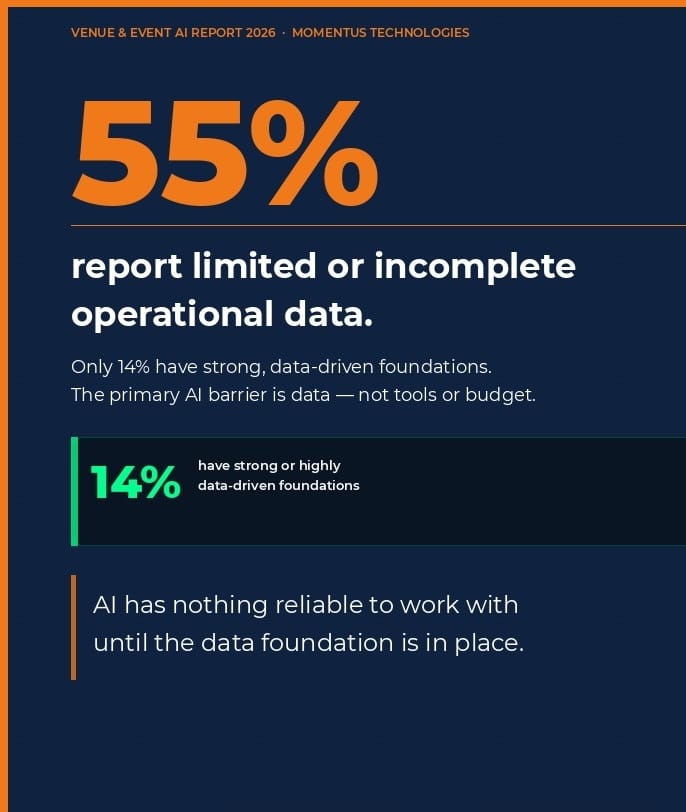
The report’s most important finding may be the one underneath the AI conversation entirely. Most venues already have technology in place, but those systems are not yet operating as one connected environment. Nearly 70% rate themselves as moderate to advanced in technology use, yet only 3% say they are best-in-class. Even more telling, 55% report limited or incomplete operational measurement, while only 14% say they have strong or highly data-driven foundations. That is the core readiness issue. AI cannot reliably improve what organizations are not consistently measuring.
Department-level adoption is uneven, with AV/Production leading, followed by Sales & Booking and Finance, while Safety/Security, Guest Experience, and Catering trail behind. In practical terms, that means many venues are modernizing in pieces rather than as a coordinated operating system. The cost of that unevenness shows up in exactly the places the report identifies as pain points: coordination, visibility, forecasting, and execution across teams.
Respondents also draw a clear line on how they want AI to show up in the workplace. Sixty-six percent prefer human-led operations with technology support. Another 18% want humans and technology balanced equally, while only 10% prefer a tech-led model with human oversight. The priority is not replacing operators. It is giving operators better visibility, faster support, and less administrative drag as they manage increasingly complex live environments.
Fifty percent of respondents expect AI to be core to their operations within the next two years, while only 7% are actively piloting or scaling it today. That spread defines the window now open across the industry. The venues that connect booking, staffing, reporting, and execution data first will be in the strongest position to move AI from productivity layer to operational advantage. Everyone else may still be interested, but interest alone will not close the gap.
By the Numbers
64% rate AI as highly significant.
7% are actively piloting or scaling AI use cases.
80%+ are exploring or evaluating AI.
45% expect AI to become part of daily operations within one to two years.
75% want AI to reduce data entry and administrative work.
62% want better operational insights and summaries.
71% say coordinating changes across teams is the top operational area needing better technology.
60% say staffing and resource forecasting needs better technology.
42% would use AI first to eliminate manual coordination across teams.
34% are evaluating or piloting AI for data entry and admin tasks.
29% are evaluating or piloting AI for operational insights.
16% are active in staffing and resource decision use cases.
Under 9% are active in real-time monitoring.
52% say AI lacks venue-specific context.
48% say AI lacks real-time operational awareness.
62% cite security and data privacy as a top concern.
57% cite trust in AI-generated decisions.
46% cite integration with existing workflows.
Nearly 70% rate their venue technology as moderate to advanced.
Only 3% say they are best-in-class.
55% report limited or incomplete operational measurement.
Only 14% say they have strong or highly data-driven foundations.
66% prefer human-led operations with technology support.
50% expect AI to be core to operations within two years.


